
Learning like play: Why screen-free time helps growing minds focus
Parents hear a lot of conflicting advice about screens. One expert says a little educational video is fine. Another warns that any early exposure can shape how a child’s attention develops. The truth sits somewhere in the middle, but one pattern shows up again and again: kids who spend more time in open-ended, hands-on play tend to build stronger focus than kids who spend most of their free time on screens.
This isn’t about banning devices forever. It’s about understanding what screen-free time actually does for a developing brain, and finding realistic ways to make more room for it.
What happens to attention when screens take over
Young children’s brains are still learning how to sustain focus on one thing at a time. That skill, often called attention regulation, develops through repeated practice: stacking blocks, following a story, waiting a turn in a game. Each of these activities asks a child to stay with a task even when it gets a little boring or difficult.
Fast-paced digital content works differently. Videos and apps are often built to grab attention through quick cuts, bright colors, and constant novelty, rather than to hold it. When a child gets used to that kind of stimulation, slower, self-directed activities can start to feel unrewarding by comparison.
Pediatric researchers have been watching this pattern for years. An associations between screen use and children’s language skills, and a related 2022 study in JAMA Psychiatry linked screen time with behavior problems in children age 12 and younger. None of this means a video here or there will derail a child’s development. But it does support what many parents notice at home: the more screen time crowds out hands-on play, the harder it seems for kids to settle into quiet, focused activity.
The American Academy of Pediatrics has shifted its guidance over the past few years. Rather than a strict hourly limit for every age, the current advice centers on making sure screen time doesn’t replace the exploration and hands-on play young children need. For infants and toddlers especially, the recommendation is simple: real-world play should come first, and screens should never be the default filler for open time.
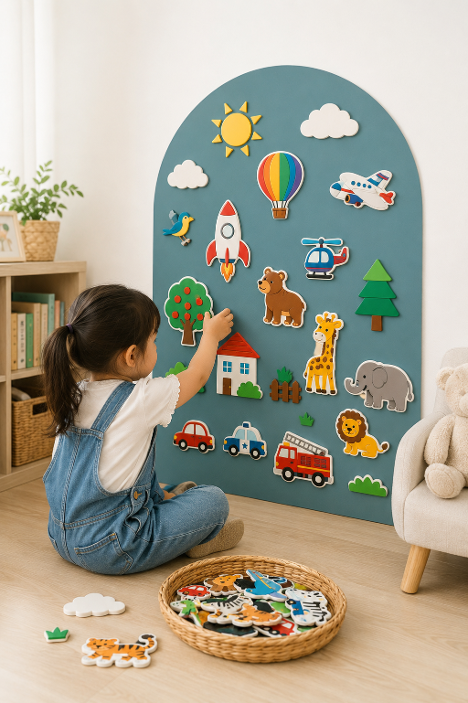
This is exactly where screen-free play tools earn their place in a family’s routine. Magnetic boards, building sets, and other tactile toys give kids something to manipulate with their hands while their mind stays engaged with a single task. Brands like Tix&Mix design their products around screen-free magnetic play, giving kids a screen-free outlet that keeps focus on real-world play, the same kind of open-ended engagement pediatric researchers point to when they talk about healthy attention development.
Why hands-on play builds skills screens can’t
It’s worth separating “screen-free” from “old-fashioned.” A well-designed physical toy isn’t just an alternative to a tablet. It teaches things a screen simply can’t.
Cause and effect, learned through touch
When a toddler stacks a tower and knocks it down, they’re running a tiny experiment. They see what happens, adjust, and try again. This kind of trial-and-error learning happens in real time, with real physical feedback. A screen can simulate cause and effect, but it can’t replace the sensory information a child gets from touching, moving, and rearranging real objects.
Sustained, self-directed focus
Open-ended toys don’t tell a child what to do next. A pile of magnetic tiles or a set of building blocks has no built-in ending, no next level, no notification pulling attention elsewhere. The child has to generate their own goal and stick with it, which is a much closer match to the kind of focus they’ll need later for reading, schoolwork, and problem-solving.
Fine motor development
Picking up small pieces, fitting shapes together, and adjusting objects by hand all build the fine motor control kids need for writing and everyday tasks. Occupational therapists often point to block play as one of the most effective tools for building hand-eye coordination in young children. This kind of physical practice simply doesn’t happen through a touchscreen, where most of the “interaction” is a swipe or a tap.
Social skills that only happen off-screen
Play with siblings or friends around a shared physical activity naturally includes negotiation, turn-taking, and conversation. Two kids building the same structure have to talk, compromise, and problem-solve together in a way that solo screen time doesn’t require.
Making screen-free play realistic for busy families
None of this means parents need to feel guilty about every screen minute. It means being intentional about what fills the rest of the day. A few practical starting points:

None of these changes require throwing out every device in the house. They’re about shifting the default, so that hands-on play is the easy choice, not the one that requires extra effort.
A Note on Screens Themselves
It’s also fair to say screens aren’t the enemy. Video calls with family, some educational content, and co-viewing with a parent all have real value, and pediatric guidance now reflects that nuance rather than treating all screen time the same. The concern isn’t the existence of screens. It’s when screen time becomes the default filler for every quiet moment, crowding out the kind of unstructured play that builds attention in the first place.
Parents who want a more structured way to build these habits at home can find plenty of practical, real-world approaches to screen-free routines here on the site, from daily schedules to age-by-age tips that fit into a normal, busy household.
How This Looks at Different Ages
Screen-free play doesn’t mean the same activity for every stage. What holds a toddler’s attention looks nothing like what keeps a seven-year-old engaged, and knowing the difference helps parents pick tools that actually get used instead of forgotten in a closet.
Toddlers (1–3 Years)

At this age, the goal is simple sensory exploration. Big, chunky pieces that are easy to grip, stack, and knock over give toddlers the cause-and-effect feedback their developing brains are looking for. Sessions will be short, sometimes just a few minutes, and that’s normal. The point isn’t length, it’s repetition over days and weeks.
Preschoolers (3–5 Years)

Preschoolers start to layer imagination onto physical play. A set of magnetic shapes stops being just shapes and becomes a house, a rocket, or a zoo. This is also the age where turn-taking and sharing start to matter more, so toys that work well with a sibling or friend get extra mileage.
Early Elementary (6–8 Years)

By early elementary school, kids can handle more complexity and longer stretches of focused play. Pattern-based and building activities start to connect naturally to early math concepts, like symmetry, counting, and spatial reasoning, without ever feeling like a worksheet. This is often when open-ended toys shift from “playtime” to genuinely supporting schoolwork, quietly reinforcing skills a child is also learning in the classroom.
Matching the toy to the stage matters more than the price tag or the brand. A tool that’s too simple gets abandoned out of boredom; one that’s too advanced gets abandoned out of frustration. The sweet spot is something that still takes a bit of effort but rewards that effort quickly enough to keep a child coming back.
Practical Takeaways
Attention isn’t something kids are simply born with in a fixed amount. It’s a skill built through repetition, and the kind of play a child does every day either strengthens that skill or works against it. Open-ended, hands-on activities ask a child to generate their own focus and stick with a task, which is exactly the kind of practice that pays off later in school and beyond.
The goal isn’t to eliminate screens completely. It’s to make sure they aren’t the default answer to every quiet moment. A simple shift, like keeping a few open-ended toys within easy reach and carving out consistent device-free windows, can make screen-free play the natural choice rather than a battle. Over time, that consistency is what shapes how well a child can sit with a task, work through a challenge, and stay curious without needing constant novelty to hold their interest.


Leave a Reply