
How to teach your child about money in a practical way
Formal education – be it through school or home-schooling – is essential for every child. Maths, grammar, science, history, geography are all important for a rounded education, but what is just as important is practical learning. Learning the ways of the world through first-hand interaction or experience.
Learning to add/ subtract/ multiply/ divide and answer test questions on the same is all good (practice makes perfect I believe) but putting those principles to actual use in daily life is an altogether different matter. While teaching children about the concept and value of money from an early age is important, it is not possible for them to be able to deal with real money on a daily basis. But I’ve got the perfect solution: let your child learn about money and how to use it in a more practical, child-friendly way via educational money-related games.
Mortgage Calculator is primarily a money and finance website, but there is also an amazing gaming section that focusses on educational (and fun) money-based games. My son and I have been trying them out over the past two months and while I love the idea of introducing him to the concept of money and handling it in a more fun way, he is enjoying playing these ‘edutational‘ games.
There are a couple of games I’d like to talk about in detail, but before that there are a few things I’d like to mention about using this site:
- For starters, I like the fact that there are no pop-up ads in the gaming section which makes the experience both, more enjoyable and safer for children (you can never be too careful with what kids can access online these days).
- Secondly, all these online games are free to access and require no email sign-ups or logins, making it easier for children to use them independently.
- The games are clearly categorised according to type/ subject, for instance: grocery store games, restaurant simulation games, money games and for older children, games revolving around cryptocurrency, business and real-estate. This means you can choose the kind of games according to your child’s age, understanding and interests.
Below are a few of our favourites, but do browse the site and see what piques your child’s interest; you will be surprised how much they can pick up from a simulation game!
Money-related games
The Money Games section focusses on the basics: counting money and making change. The Cashier Simulator is, in my opinion, a great way to teach your children about getting and giving change and I like that it is based in a grocery store (practical choice) where the player operates the cash register. Grocery Cashier is another game along similar lines but more catered to younger children (so a great game to get kids involved with money from a young age as well as practice their addition and subtraction skills).

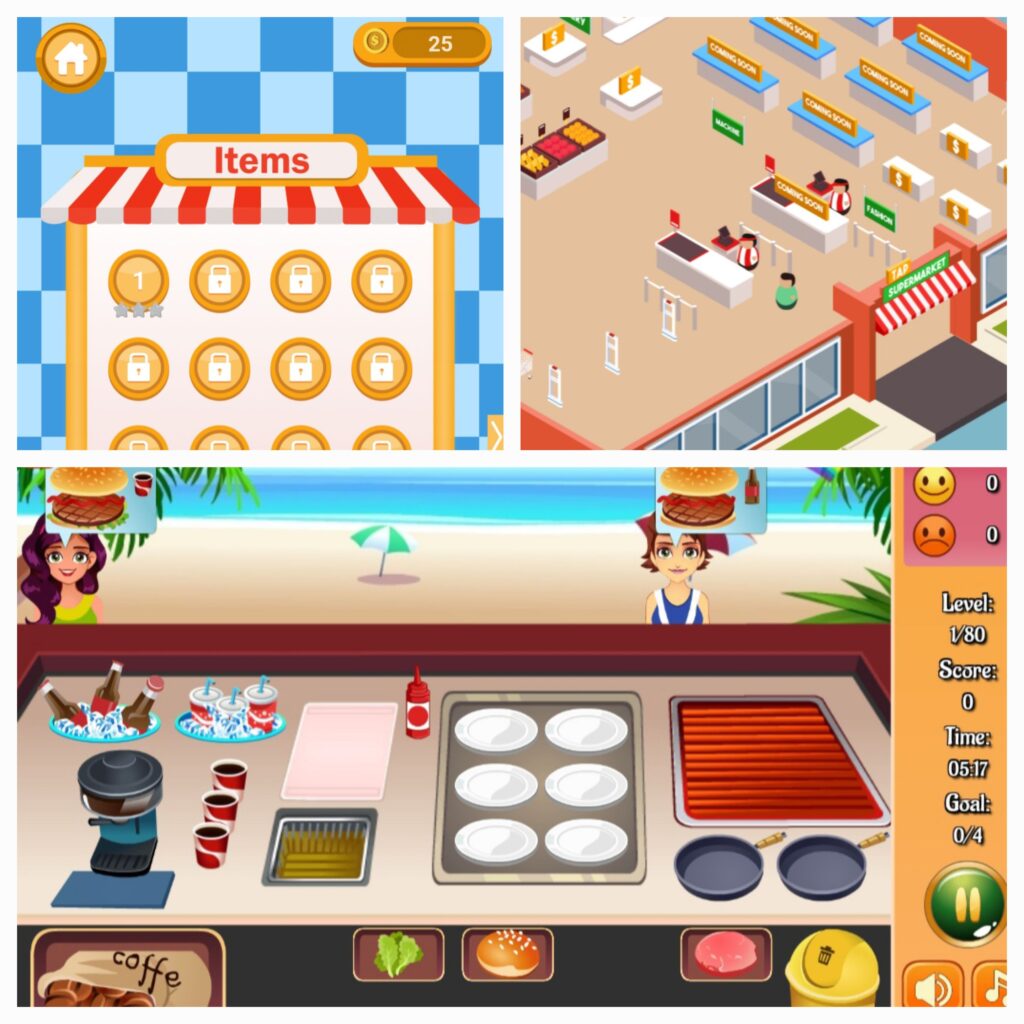
If your child enjoys the above, then you can check out the Grocery Store Games section that has games like Tap Supermarket where your child actually manages a store – does an inventory and stocks items, checks out customers and uses profits to expand the product line. This is a great simulation game to teach your child how one’s earnings can be used to invest and create further profit.

Simulation games
The Restaurant Simulation games section is another of our favourites (maybe because we enjoy eating out or perhaps because there are games based on pizza and burgers – which my son loves – and coffee and chocolate – which I love).
Just as in the supermarket simulation game, Open Restaurant gives your child a feel of actually running a restaurant – from inviting guests inside to taking their orders, serving their food, giving them their bill and clearing the table and even teaches them how to achieve their daily earnings goal for the restaurant. There are other practical aspects to this game as well, for instance, your earnings from the prior day get carried forward to the next and there are challenges as well – after you complete a week of running the restaurant, the difficulty of the game ramps up and it’s up to you to balance all aspects of the restaurant to keep the cashflow running.

I love Hotdog Cart too as it teaches children about another essential life skill – time management! It is a simple game but requires quick thinking skills and effective use of time. You have to look at the thought bubble above each customer’s head to find out what food/ drinks they want, along with how much time you have remaining to serve their order. There are also mini challenges involved to make things more exciting: you have to complete their order before their patience timer runs out; pull the burger off the grill after it is cooked, but before it is burned; when assembling a burger you have to set the bun down first; and sometimes customers could leave angry if their orders are not completed.

Business and coding-related games for the older child
If you have an older child, then do also check out the Business, Software Development and Real Estate Simulation Games, especially if your child is interested in these subjects and in coding. Code Panda is great for introducing your child to programming whereas Rubi’s Coding Class is a logic-based video game, great for improving their non-verbal reasoning skills.

In conclusion, these games are a great way of teaching your children about handling and dealing with money in a more relaxed, fun manner. Because it is possible to learn from beyond the textbook too…


Leave a Reply